If you want to support this project, click the PayPal Donation Button

Friday, June 10, 2011

Noise Annoys (and Delights)

Maybe it's because it's the dog days of summer, but I'm wading slowly through the letter N. I've found a bevy of nurses and other N images to add to last week's NEWSSTANDS, but I've been slow in scanning them.


But the folder I wasn't expecting to find is the folder for NOISE. It's not really something you can SEE, is it?


My father's birthday is coming up soon, and he was a guy who loved noise. In fact, I still have a few mix tapes he gave me. There was a little box to check on some tapes that said "noise reduction." On one tape, my dad scrawled in "HELL NO!!!!!" next to that box. He liked it loud, and you can read about it in a collection of his work, Blues & Chaos: The Music Writing of Robert Palmer, which comes out in paperback in September. So in honor of my dad's birthday, I'm going to just load up a few pictures of NOISE, transcendent and annoying here.

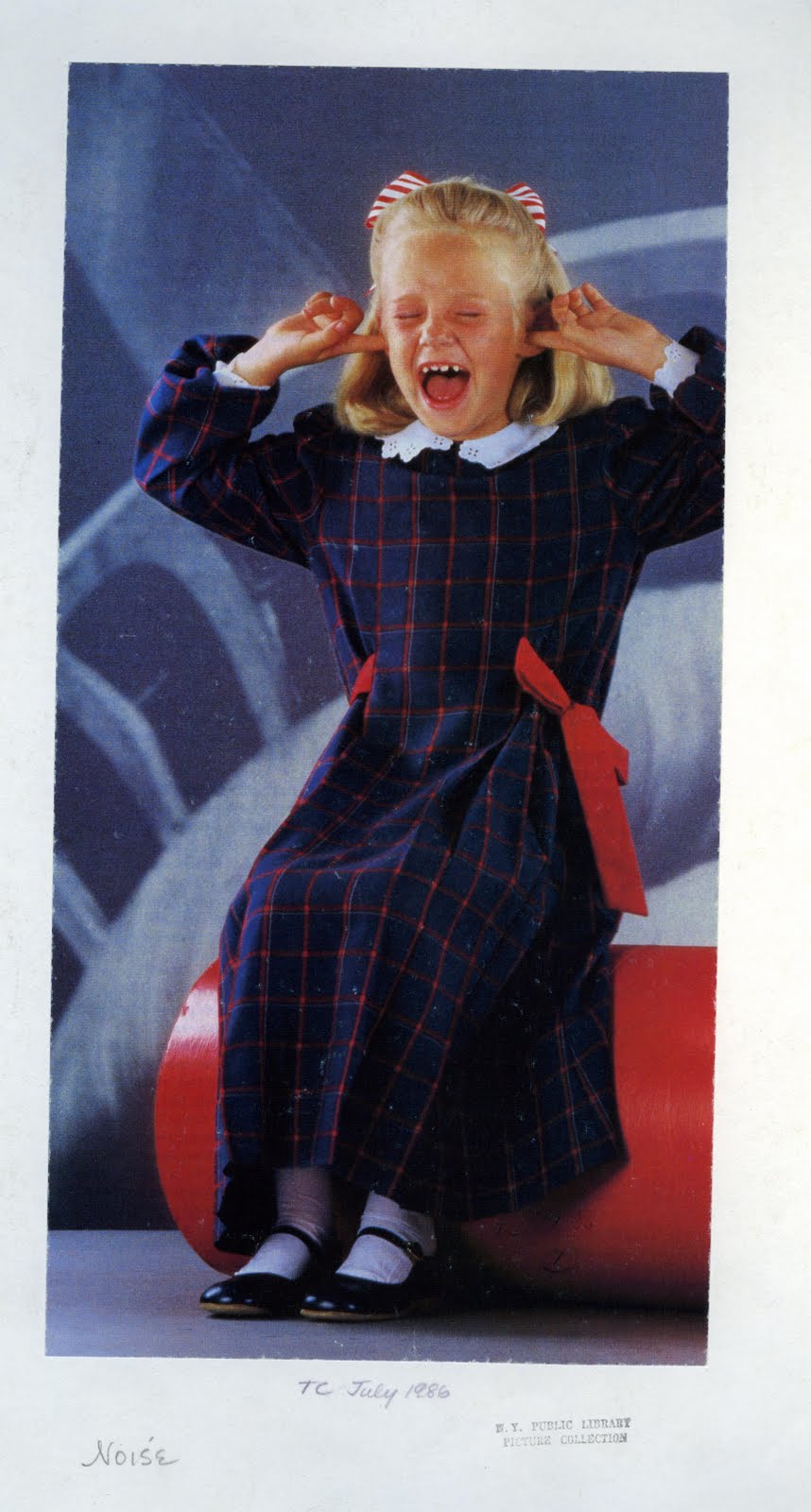
Strangely enough, I found an image in this file made by my father's friend David Katzenstein in this folder. It even, inexplicably, had a stamp on it from Tangier, a city they visited together:


This is one of a large group of images about the experience of noises that might make you plug your ears:


There are also a couple of images paired with text about Moms who can't hear themselves think or get their babes to sleep. As a person who's experienced both ends of this, I couldn't resist them:


Cue the Buzzcocks singing," Pretty girls! Pretty boys! have you ever heard your mommy say, 'Noise annoys.'"


There are couple of images about things that block or prevent noise:

 
But I really love the methods and machines for measuring noise:
labeled as "Noise Analyzer"


This last one is one of my favorites, especially since I've been feeling recently that my mission in life is to make remedial music films for visual people (a.k.a.sonically challenged people like myself).I AM a Synthane Noisometer.

Maybe.

Hopefully I'll get the professional help I need at this year's Flaherty Seminar, appropriately titled "Sonic Truth."


Thursday, June 2, 2011

N is for Newstands: Young Women Going Places & Keeping up with the Times


I've begun looking for images in the letter N, and the first folder I looked at was Newsstands. This young woman was really going places in the 1950s... of course. Nearly twenty years later, the New Yorker ran a cartoon that implied she might have added Ms. Magazine to her newsstand wish list.


Somehow the idea of newsstands takes me back to Alexander Mackendrick's brilliant New York newsworld noir, The Sweet Smell of Success. The film stars Tony Curtis and Burt Lancaster (as J.J. Hunsecker, a gossip columnist cookie full of arsenic)."The cat's in the bag," Curtis' character says, "and the bag's in the river." It's all shot in the most beautiful black and white, as if it had been drenched in the newspaper ink that fills J.J. Hunsecker's veins.

Naturally, I found a few older images that evoked that newsprint world, though neither was from New York.
Paris, 1951

Texas, 1920s


And then were a few that surprised me. A beautiful pink newsstand from Ireland, a color newsstand from Fortune Magazine 1948 that looks shockingly contemporary, a  San Francisco Chinatown stand, and Mike's of Harlem - a piece of folk art where you can buy candy or news.


But the image that surprised me the most was another woman at a newsstand, a woman minding her own stall on the street.

This, in turn, reminded me of Hilary Mantel's beautiful 1992 novel about the French Revolution, A Place of Greater Safety. It was the first book which made the characters of Danton, Robespierre, and the fascinating Camille Desmoulins. Both Mantel's book and this image are reminders of how long our world has been defined by media. Harking back to the first image in this entry, this "marchande de journaux" seems to be both definitively "going somewhere" and simultaneously "keeping up with the times." Both of these images of women - as news consumer and news purveyor remind me of a snatch of a poem from the collection Ghost in a Red Hat by Rosanna Warren; a poem that I read earlier this week:

...the mystery was,
not that she walked there, ten
years after her death,

but that she vanished,and let 
twilight take her place  --

I love to see these women emerge "walking" or sitting - in some cases centuries after their deaths - from folders in the Picture Collection. 

Warren wrote the poem for her mother, and one image of an ancient mother has been haunting me. 
She's not as old as the goddess from Chauvet Cave that Werner Herzog captures in The Cave of Forgotten Dreams, but she is described as 5,000 year old tomb statue in the 1960 Columbia Record Distributors booklet her image comes from, which somehow found its way to the MUSIC - ANCIENT EGYPTIAN  folder, part of the amazing archive of the letter M....

Thursday, May 26, 2011

The Zodiac in the Night Sky and Diogenes' Lantern

These Lights
Inside water, a waterwheel turns,
A star circulates with the moon.

We live in the night ocean wondering,
what are these lights?

Reading Rumi's poem  above made me want to revisit the images I'd culled from the letter Z, because I'd wanted to combine images of ZOOLOGICAL GARDENS with a turning ferris wheel in the night sky created from ZODIACs.

I started with the zoo from Barrackpore and a renaissance Zodiac:

But then remembered that I'd wanted a night sky and planned to include the ruins of Great Zimbabwe, so I revised it a bit:

(You can see more of the source material for the letter Z in this earlier post.)

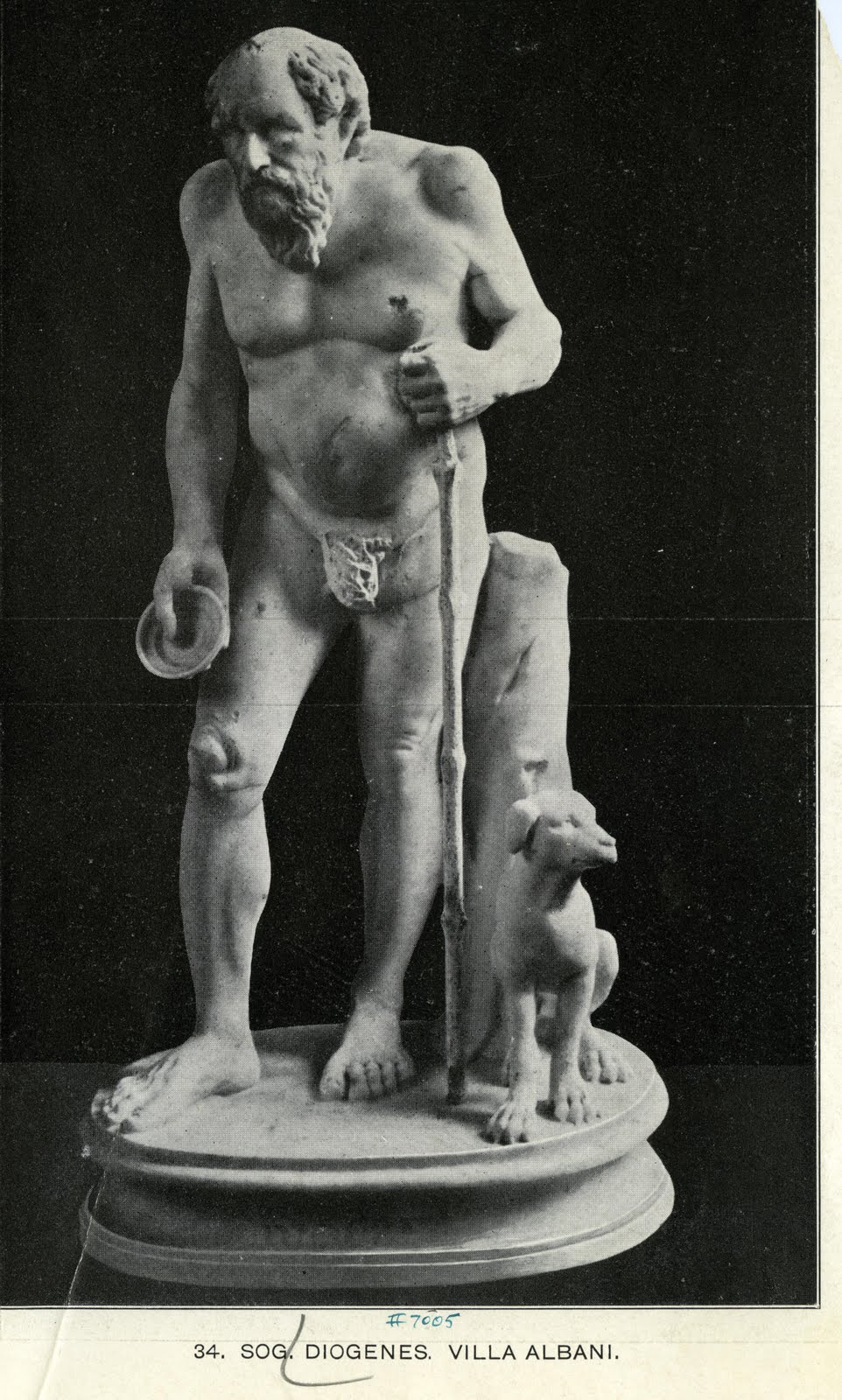
Thinking about images of light, I was reminded of  Diogenes, the Cynic philosopher who was famous for going around with a lantern in his hand in broad daylight, looking for an honest man.
An engraving of Diogenes included in  a book on the history of hairstyles. (source code 15,218)
Undated image

1865 illustration

1946 William Gropper image.

1907 Harper's Magazine Illustration

My friend Sohrab Sadaat Ladjevardi, a great sax player who has a band called the Tehran Dakar Brothers, mentioned Diogenes to me recently, and that's why I went looking for his image. I found it in a folder marked PERSONALITIES: DIO. The PERSONALITIES folders are one of the largest categories in the Picture Collection and line most of one wall. Arranged alphabetically, like most everything else in the collection, the famous people in PERSONALITIES: DIO ran the gamut of trades and historical eras.  A few of the folks sharing that folder with Diogenes include:
Christian Dior NYT, 1953
The Dionne Quints from a 1979 NYT Magazine cover
And all grown up in Life Magazine, 1952
Dioscorides, a Greek physician at the court of Nero pictured here in a 13th century Arab manuscript.

Ronny James Dio was inexplicably absent. Diogenes, however, took up the lion's share of the folder. His insistence on living in a tub (essentially a trash bin), his rigorous rejection of material possessions, and his playful cynicism have inspired artists for thousand  of years. There are myriad representations of him from varied sources and eras. A few of my favorites include:


1979  Ad for insurance, which insists you can still be wise, even if you don't choose to live like Diogenes...  


There are also quite a few images of the story my friend Sohrab had reminded me of. It seems Diogenes was a celebrities celebrity, and one of his "fans" was Alexander the Great, who stopped by Diogenes' tub one day. Alexander purportedly asked if there was anything he could do for Diogenes. "Yes," the crusty cynic replied sardonically, "You can get out of my light. You are blocking the sun."

1799 Atelier LeGrand

1895 London Illustrated News

15th Century French manuscript

1923 magazine illustration


National Geographic illustration, 1949
I love the shifting historical representations of Alexander, Diogenes, and the tub, and the way their characteristics change, especially Diogenes, who sometimes appears as an irascible crank and other times as appears as a respected sage.

I'm not sure how or whether I will use these images in the film. Perhaps, it occurred to me, I could place a series of  "PERSONALITIES"  in a playground?

I went to look at the PLAYGROUNDS folders, and the first thing I found was a strangely misfiled image from PUNISHMENTS. I decided it was time to call it a day, but I leave you  with that image, which depicts a very adult playground...


(Thanks to Chris Arnold for German translation help.)

Thursday, May 19, 2011

Shadows of Forgotten Ancestors, with a side trip to Madagascar

I collected more images for M than for any other letter so far. Some of them, like the beautiful images of Music: Ancient Egyptian, will be filed away for later. For a bit of a change, I thought I'd put in my working sketch first, then break down what went into it.


The bear on a magic carpet and the large May Day engraving, some readers will recognize from last week's entry.


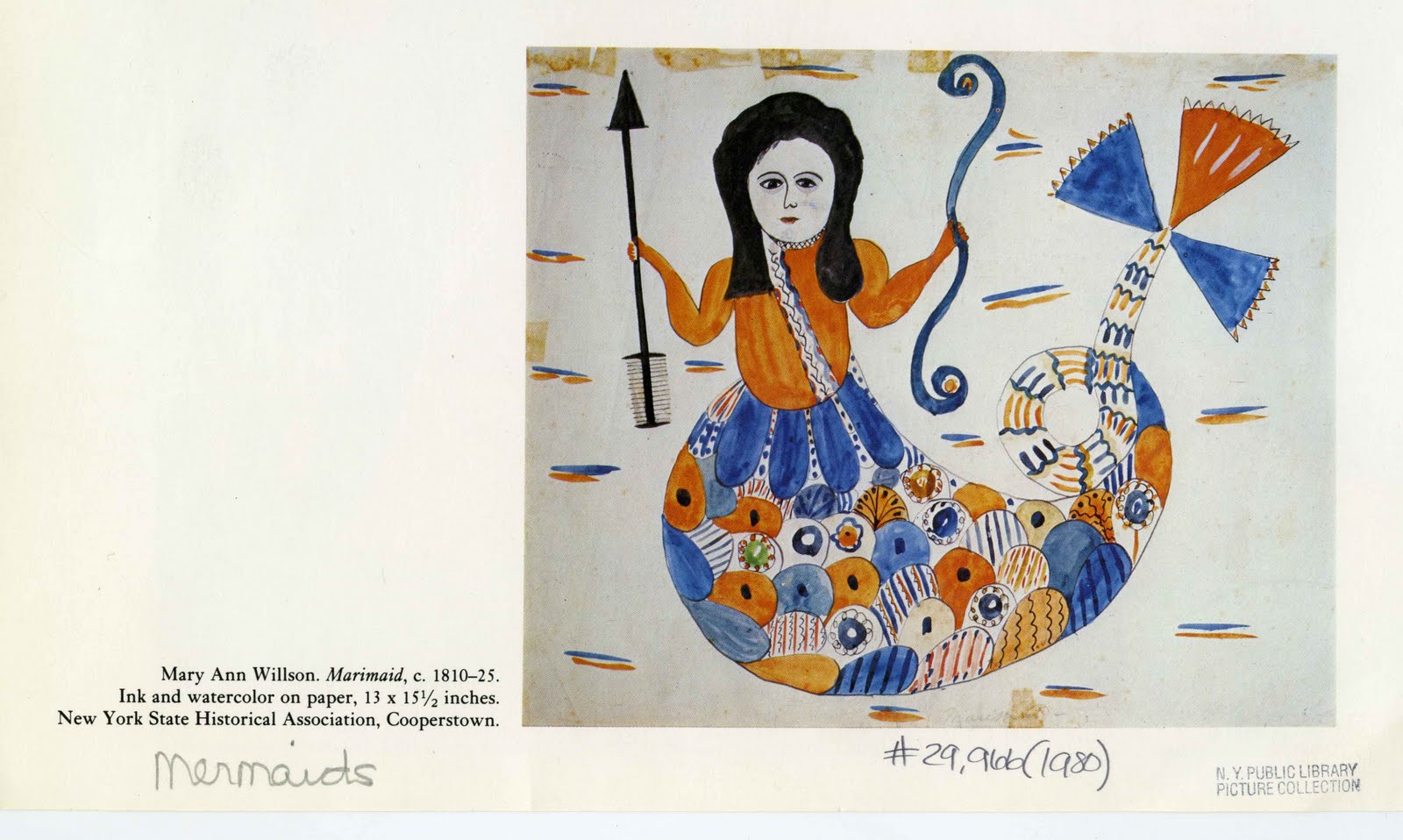
 The Mermaids near the center come from  a small selection I made, which also includes "the chicken of the sea":

As well as quite a few other merfolk:
Early American folk art from New York state (C. 1810)


There are two images from the folder MAYAS:
1930s National Geographic illustration

The second image is a figure who looks regal but benign, yet the handwritten caption indicates that this Chac Mool has a receptacle on its stomach "for offerings, usually fresh blood or pulsating hearts." He seems pretty blase about the whole thing, looking away as if he's not even interested in whether he's got a pulsating heart for breakfast or not. One wonders about the source of this material, but I'm giving it to you uncited, as it came across my table in the Picture Collection.

Before MAYAs, I looked through many images in MADAGASCAR: LIFE. It looks like one of the most beautiful places on earth, but somehow the composition of the landscapes I found didn't grab me as much as the raucous May Day image I chose as a base for the sketch above. I really wish I'd found a place for the gentleman below, however.

He is a musician who plays while dancers perform in the Malagasy ritual of Famadihana, or turning the dead, when ancestral bones are exhumed, feted, and wrapped in new shrouds during the Malagasy winter.

I claimed earlier not to be obsessed with death, but my forays in the archive prove otherwise...

In the sky with the Chac Mool are a few of the beautiful images I found in MASKS - AFRICAN. I've chosen a few more that didn't make it in to show you here.

Buale funerary mask, Ivory coast

Unlabeled mask found on the reverse of the image above

Kwele face mask, Gabon or Congo


Ivory, Benin

Left is Lega, Zaire, Right is a Pende mask also from Zaire (Now Democratic Republic of Congo)

Punu, Gabon, wood

Congo

And there are three masks included in the mock-up for the letter M that it's nice to get a fuller look at.
Dan-Ngere mask, 1974 (Dan or Gio people are Mande speakers from Liberia and Cote D'Ivoire)

Bamileke Elephant mask, Cameroon

Bateke mask, Congo (Brazzaville), publication 1960s

These masks are unbelievably beautiful, and their totemic quality made me want to place a few of them in the sky alongside the Chac Mool. I love that each photograph has what I would call its own aura, derived from the photographic techniques used (especially the lighting) and the time and setting in which its image was captured. Somehow vestiges of these auras remain even when the masks are extracted from the photograph. When I make more formal versions of these sketches, I hope to preserve those auras, the shadows and outlines that are remnants of lost times and ancestors.


Stay tuned next week for a tangent into PERSONALITIES: DIO, or maybe it will be NEWSTANDS and NIGERIA.... who knows.