If you want to support this project, click the PayPal Donation Button

Thursday, May 19, 2011

Shadows of Forgotten Ancestors, with a side trip to Madagascar

I collected more images for M than for any other letter so far. Some of them, like the beautiful images of Music: Ancient Egyptian, will be filed away for later. For a bit of a change, I thought I'd put in my working sketch first, then break down what went into it.


The bear on a magic carpet and the large May Day engraving, some readers will recognize from last week's entry.


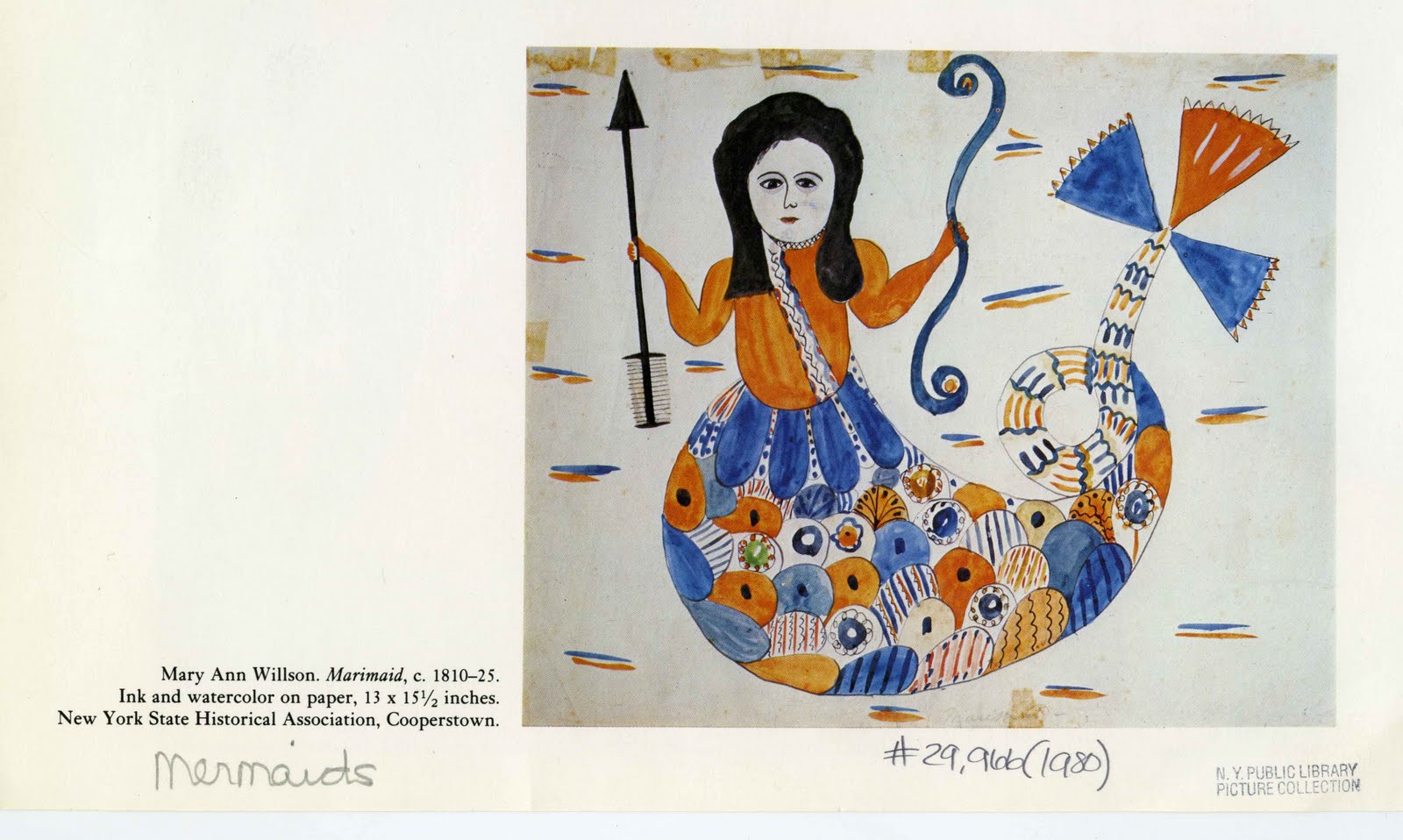
 The Mermaids near the center come from  a small selection I made, which also includes "the chicken of the sea":

As well as quite a few other merfolk:
Early American folk art from New York state (C. 1810)


There are two images from the folder MAYAS:
1930s National Geographic illustration

The second image is a figure who looks regal but benign, yet the handwritten caption indicates that this Chac Mool has a receptacle on its stomach "for offerings, usually fresh blood or pulsating hearts." He seems pretty blase about the whole thing, looking away as if he's not even interested in whether he's got a pulsating heart for breakfast or not. One wonders about the source of this material, but I'm giving it to you uncited, as it came across my table in the Picture Collection.

Before MAYAs, I looked through many images in MADAGASCAR: LIFE. It looks like one of the most beautiful places on earth, but somehow the composition of the landscapes I found didn't grab me as much as the raucous May Day image I chose as a base for the sketch above. I really wish I'd found a place for the gentleman below, however.

He is a musician who plays while dancers perform in the Malagasy ritual of Famadihana, or turning the dead, when ancestral bones are exhumed, feted, and wrapped in new shrouds during the Malagasy winter.

I claimed earlier not to be obsessed with death, but my forays in the archive prove otherwise...

In the sky with the Chac Mool are a few of the beautiful images I found in MASKS - AFRICAN. I've chosen a few more that didn't make it in to show you here.

Buale funerary mask, Ivory coast

Unlabeled mask found on the reverse of the image above

Kwele face mask, Gabon or Congo


Ivory, Benin

Left is Lega, Zaire, Right is a Pende mask also from Zaire (Now Democratic Republic of Congo)

Punu, Gabon, wood

Congo

And there are three masks included in the mock-up for the letter M that it's nice to get a fuller look at.
Dan-Ngere mask, 1974 (Dan or Gio people are Mande speakers from Liberia and Cote D'Ivoire)

Bamileke Elephant mask, Cameroon

Bateke mask, Congo (Brazzaville), publication 1960s

These masks are unbelievably beautiful, and their totemic quality made me want to place a few of them in the sky alongside the Chac Mool. I love that each photograph has what I would call its own aura, derived from the photographic techniques used (especially the lighting) and the time and setting in which its image was captured. Somehow vestiges of these auras remain even when the masks are extracted from the photograph. When I make more formal versions of these sketches, I hope to preserve those auras, the shadows and outlines that are remnants of lost times and ancestors.


Stay tuned next week for a tangent into PERSONALITIES: DIO, or maybe it will be NEWSTANDS and NIGERIA.... who knows.

Thursday, May 12, 2011

May Day, Mayday! Pick UpYour Moving Picture Cameras, Ladies!

The Letter "M" will get two entries rather than one, simply because it's chock full of beautiful stuff:
Music, Madonnas, Mythology, Masks (of all kinds and provenance), Mayas, Madagascar, and much more. Only a few categories provided less than I expected. Magic Carpets seemed pretty thin, though I love this bear from a car ad:

Perhaps someone else had taken all the other magic carpets home with them....

My other life as a film scholar drew me to the many folders for Moving Picture Cameras and the Moving Picture Industry. I just picked through them, randomly pulling out images that grabbed me, like this one:


I can certainly imagine "150 OF HIM" staring me in the face, and he seems a nice enough guy, but the rest of the images I chose could fit into a (fictional) folder labeled Woman With a Movie Camera. Imagine 150 OF HER:

Mary Pickford looks swell with several Mitchell movie cameras & one Bell & Howell.

And I loved this image of a seemingly intrepid CBS employee behind the (video) camera in 1978:

The caption notes that "she wants to makes films but faces obstacles - having less to do with male domination than 'insecurities I have about risks.'"

 I also picked up a couple of ads for home movie cameras marketed to women.
Detail from a 1920s Saturday evening post ad


The Filmo25 came in three colors and the lady on the left of the image looks great using hers. I'm not really sure "the most exciting camera ever designed" (the second image) would have really lasted a lifetime, but I do appreciate the lovely hands holding it "with pride."

When I realized I'd been unconsciously looking for images of women and tracing a historical arc through representations of women with cameras, I went to a folder where I knew I'd find a lot more women: the Madonnas folder. There were many sumptuous images, but two Italian paintings stuck with me:


This Da Messina painting depicts something both my kids continued to do long after they had stopped
breast-feeding; just checking to see if there was anything still down there, I guess. But I've never seen this represented in a painting, so it makes this madonna seem more intimate, more like a casual snapshot of family life than a painting-as-devotional-object.

I gravitated to this Fra Filippo Lippi for other reasons:

This madonna looks so sad, she could be titled "The Madonna of Post-Partum Depression." And her son looks smug, somehow, rather than god-like or even cherubic.

Though May day is long over now, I found myself looking at a range of May day images:


My brother Peter, a source of nearly unending historical fact and arcana, told me last year that May Day had a special significance in New York during the 19th century. It was a kind of universal moving day, when everyone who could moved to a new house. I believe the tradition sprung up because a city ordinance declared that all moves had to take place by May 1st in order for residents to be listed in the new city directory. So I was delighted to find a funny, ribald image of that particular May Day tradition:

And I was interested to see that it wasn't always just fun and games putting up the maypole. In fact, it could make raising the flag at Iwo Jima look easy, as in this detail from a steel engraving made in the 1850s.

But my favorite May Day image is from an unknown source, a May Day song signed by early 20th Century illustrator Edna Potter.
My six year-old daughter, Laila, who cannot read music, has now pulled this out a couple of times and begun singing these lyrics to a tune of her own composition .

As I was finishing up the scanning of thees images, I was no closer to a unified world for the letter M, but I was hearted to read another Rumi poem -

Whatever You Really See
A human being is essentially
a spirit-eye.

Whatever you really see,
you are that.


So I guess I'll keep looking...

Thursday, May 5, 2011

A Looming Laplander Guards a Lighthouse Labyrinth


Walking down the aisles of L, I pulled out the files for Labyrinth and found these:


I looked in vain for a picture of my favorite labyrinth, constructed at the Yuan Ming Yuan, or old summer palace outside Beijing. The place is a ruin of the palace and gardens designed by Guiseppe Castiglione and other Jesuits to please the Qianlong emperor. But the images above are evocative and mysterious enough. It's just a little tricky to figure out how to use a labyrinth without it taking over the frame.

I also knew I wanted to look for images of Lapps. I was struck by the grittiness of some of the images I found, as well as by the confrontational, proud stares with which these Lapps greeted the camera.


I was also interested to read about their magical drumming tradition, pictured here:
These drums spoke not only through sound, but also through the runes inscribed on their drumming surface.

I was amazed (as usual) at the breadth of the collection of images, including this SAS airline menu image from the early 1970s:
Did a librarian bring this home from her/his vacation? Or how did it wind up here in the picture collection?

I also loved the thousands of images of lunch boxes, of which I've selected just a handful here.


And, of course, there are beautiful images of libraries, both the fixed and the traveling variety:


This beautiful Prague library has reappeared in my dreams ever since I saw its image, but the traveling library images brought back to me the smell of the bookmobiles I visited a few times as a child in Little Rock, Arkansas. I was drawn to later images, but was impressed at the variety of mobile libraries, some drawn by horses like the ice trucks in a previous entry.

After looking through stacks of lighthouses, I suddenly saw how to combine some of these L images when I pulled out this lighthouse image from Nantucket:

The blue sky and the quality of windy isolation inspired me to pair it with one Lapp, one lunchbox, and a labyrinth:

I wonder if the aye-aye will get lost in the labyrinth, frighten the dog, or knock the pipe out of the giant Lapp's mouth?